CABARET of SPIRITS Atelier ... BLOG VERSION

CABARET of SPIRITS Atelier ... BLOG VERSION
...Photographs should be protected from extended exposure to intense light sources. Limit exhibition times, control light exposure, and monitor the condition of the photographs carefully. Prolonged or permanent display of photographs is not recommended. Use unbuffered ragboard mats, and frame photographs with archivally sound materials. Use ultraviolet-filtering plexiglass to help protect the photographs during light exposure. Reproduce vulnerable or unique images and display the duplicate image; in this way, the original photograph can be properly stored and preserved.

Disaster preparedness begins by evaluating the storage location and the potential for damage in the event of a fire, flood, or other emergency. It is important to create a disaster preparedness plan that addresses the specific needs of the collection before a disaster occurs.

The location and manner in which photographs are housed can be the first line of defense. Identify photographic materials that are at higher risk of damage or loss. Remove all potentially damaging materials such as paper clips and poor-quality enclosures. Store negatives and prints in separate locations to increase the possibility of an image surviving a catastrophe. If a disaster occurs, protect the collection from damage by covering it with plastic sheeting and/or removing it from the affected area. If using plastic, make sure not to trap in moisture as this could lead to mold growth. Evaluate the situation and document the damage that has occurred. Contact a conservator as soon as possible for assistance and advice on the recovery and repair of damaged materials.

PS .If your photograph requires special attention or you are unsure about how to protect it, you should contact a conservator.To search for a conservator near you.


Cabaret of Spirits ATELIER

Cabaret of Spirits ATELIER

Treatment Options for Photographic Materials may include

mold removal
surface cleaning
stain reduction (only if possible and safe to do so)
tape and adhesive removal
separation from poor quality mounts
consolidation of cracked or flaking emulsion
mending tears or breaks
conservation of cased photographs and case repair
daguerreotypes
ambrotypes
ferrotypes
electro-cleansing of tarnished daguerreotypes
rehousing options
four-flap enclosures
clamshell boxes
polyester sleeves
encapsulation
conservation framing

PRESERVING & PROTECTING PHOTOGRAPHS

PRESERVING & PROTECTING PHOTOGRAPHS
Hundreds of millions of photographs have been lost over the years to natural disasters, wars, and the age-old urge to clean house. So there is something special about every old photograph that's survived. Someone decided to make it... someone else, to buy it... and a lot of someones decided to keep it over the years. Whether you're the caretaker of a treasured family album or a collector who has searched out the classics of photography, it's important to preserve and protect the images you value. Fortunately, there is new information about what to do and what to avoid. And there are specialized products available to help.

...

...

"most viewed this week on the years"

Me: I am modern day alchimist practicing photographic process of the 19th Century and the handcraft

Me: I am modern day alchimist practicing photographic process of the 19th Century and the handcraft

last year

Red light district

"When he died, 89 glass-plate negatives were found in his desk showing prostitutes taken in around 1912 in ‘Storyville‘ the red ...

my website

about me "work and lifestyle"

My photo
~ *~ It all starts as a photographer... the path leads me to specialized in the conservation & application of fine art and historic photographs and restoration of paper ... working in my Boudoir, CABARETøf SPIRITS ~ *~

Archive you missed the past months


Showing posts with label tea time. Show all posts

Tuesday, 29 October 2019

Waiting for the magical effect.


HAVING examined carefully the plate of glass, and removed from its surface any adhering fibre or dust, take it in the left hand, holding it with the forefinger and thumb by the upper left-hand corner, and with the bottle of iodized collodion in the other hand, pour from the bottle on to the glass, towards the upper right-hand corner, such a quantity of the solution as will run in a body freely.
Whilst pouring the iodized collodion on to the glass, tilt the glass slightly towards the upper right-hand corner, and when this is reached, incline the glass to the upper left-hand corner, but not touching it, to avoid coming in contact with the thumb of the left hand; this corner passed, run the iodized collodion down towards the lower left-hand corner, and finally incline the glass to the lower right-hand corner, at the same time holding the glass upright over the neck of the bottle (which should be retained in the right hand whilst the operation is going on), to allow the superfluous collodion to drain off into the bottle; during the time it is draining, move the plate vertically backwards and forwards over the neck of the bottle, to prevent the furrowed appearance the film is likely to assume if allowed to drain quietly to the lower right-hand corner.
To perform the above operation with certainty, requires a steady hand, and some little practice. After the glass has drained for a few seconds, and the collodion has ceased running from the plate, it should be immersed in the exciting bath; from five to twenty seconds may elapse between the two operations; if the drying is prolonged, the sensibility and evenness of the coating are injured, and the iodide of silver is liable to be thrown out from the film on to its surface.
Very often, in dry, hot weather, the plate will require to be immersed in the exciting bath directly the film has set; if the plate has been allowed to dry too much, the iodide from the upper part of the plate will most likely be thrown out on to the surface of the film, and be washed away by the liquid in the exciting bath. Care should be taken not to breathe upon the surface of the glass during the operation of pouring on the iodized collodion.


OXIDE OF SILVER.
Sym: AG + O.
Eq. 116. Silver 108 + Oxygen 8

Oxide of silver can be obtained from a solution of nitrate of silver, by the addition of a solution of pure potassa, or soda; oxide of silver is set free and falls as an insoluble brown powder; it should be repeatedly washed to remove all traces of the excess of potassa, or soda,and the nitrate of the alkali formed. After washing, it should be thrown upon a clean linen filter to drain, and afterwards dried; or it can be preserved in a moist state in a wide-mouthed bottle.

CHLORIDE OF SILVER.
Sym: AG + C.
Eq. 144. Silver 108 + Chlorine 36

Chloride of silver is most conveniently formed by the addition of a solution of common salt, (chloride of sodium,) to a solution of nitrate of silver. It falls readily as a white precipitate, and should be repeatedly washed, to free it from the excess of common salt, and the nitrate of soda formed during the process. After washing, it may be collected on a linen filter, and subjected to pressure to free it from moisture, and then dried, or it may be preserved in a moist state. It is soluble in ammonia, hyposulphite of soda, iodide and cyanide of potassium.


Friday, 28 July 2017

between a ball of wool and sipping a cup of tea

Midsummer tree,folk festivals around which a MAYPOLE DANCE often takes place

In Britain the maypole was found primarily in England and in areas of Scotland and Wales which were under English influence. However, the earliest recorded evidence comes from a Welsh poem written by Gryffydd ap Adda ap Dafydd in the mid-14th century, in which he described how people used a tall birch pole at Llanidloes, central Wales. Literary evidence for maypole use across much of Britain increases in later decades, and "by the period 1350-1400 the custom was well established across southern Britain, in town and country and in both Welsh-speaking and English-speaking areas."


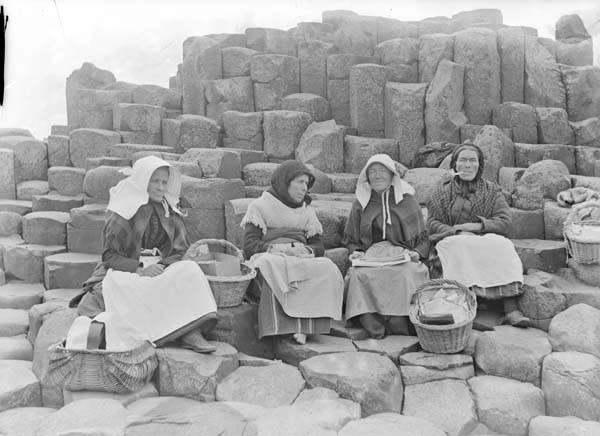
how can you not stay enchanted with these old photographs
... looking in my library a knitting book to make a sweater for this winter 
I found this book of Welsh woman  in traditional  rural dress.
1885-1905

the unique Welsh hat

The cap

Also known as the mob cap, the cap was a linen or cotton head cover with goffered  folded fabrics around the face. Some had long lappets which hung down the front below shoulder level.

The Welsh hat

The distinctive feature of Welsh hats is the broad, stiff, flat brim and the tall crown. There were two main shapes of crown: those with drum shaped crowns were worn in north-west Wales and those with slightly tapering crowns were found in the rest of Wales. They were probably originally made of felt (known as beaver, but not necessarily made of beaver fur), but most surviving examples are of silk plush (also sometimes known as beaver) on a stiffened buckram base. A third type of hat, known as the cockle hat, was worn in the Swansea area.


Sorg ond slaep 


Monday, 12 December 2016

deepening-Before Xmas


Direct carbon is commonly known as the Fresson process. It is based on the light sensitivity of chromium salts suspended in a pigmented colloid (usually gelatin) known as a dichromated colloid.
The carbon process became commercially popular in the 1860s. A sheet of pigmented dichromated gelatin was printed in contact with a negative. During exposure the gelatin hardened in proportion to the amount of light it received. The unexposed gelatin remained soluble and was washed away resulting in an image. The process was cumbersome requiring the gelatin tissue to be transferred before development (single transfer). The mid-tone areas were partially hardened from the top down so that the soluble gelatin was under the hardened gelatin. Transferring the tissue to another support allowed the soluble gelatin to be on top so that a full tonal range could be obtained. Sometimes the tissue was transferred again (double transfer) so that the image would be right-reading. If the tissue was not transferred before development, the image would lack mid-tones resulting in a blocky, contrasty image.
Beginning in the 1890s several attempts were made to introduce direct carbon papers that did not require transfer but still gave good mid-tones. The first moderately successful paper was Charbon-Velor by Victor Artigue in 1893. The process was initially introduced by his father, Frederic, who died before perfecting the process. It was developed using a slurry of sawdust and water in which the friction of the sawdust helped remove the soluble gelatin. While it was available in three colors, black, blue, and sanguine, it was found that only the black gave good though inconsistent results. The specifications of the process remained proprietary. Thédore-Henri Fresson introduced Charbon-Satin paper around 1900 as an improvement to the Artique process. Fresson also did not take out patents on his process, but rather maintained a high level of secrecy surrounding the manufacturing details so that the process remains proprietary even today.
Fresson direct carbon paper was commercially available in Europe from about 1900 until WWII and in American from 1927 to 1939 through the distributor M. Alenius. The paper consisted of pre-coated, unsensitized paper that came with a packet of sawdust. It was available in several different colors, textures, base tints and paper weights. After WWII the Fresson family operated as an Atelier and only printed Fresson direct carbon for individual artists and continue to do so today.
Four color Fresson, called Quadrichromie Fresson, was introduced in 1951 by Pierre Fresson, the son of Thédore-Henri. It is an assembly processes in which cyan, yellow, magenta, and black images are layered to form a full color image.
Only the Fresson family held the proprietary secret to the process until 1966 when Pierre sold the secret to the Spanish photographer José Ortiz Echagüe with the stipulation that it not be called Fresson and that Ortiz not share the secret. Ortiz called his prints Carbondir. Evidently the rest of the Fresson family was not aware of this agreement until the 1970s when Louis Nadeau began negotiations with Ortiz or acquire the process. Nadeau acquired the process in 1979 just before Ortiz’s death and continues to operate in New Brunswick, Canada.


in a short-time new dates ...


Tuesday, 23 August 2016

working to Abbey


Me expert in conservation treatment of a wide range of photographic materials, including historic images, family heirlooms, works of art, and archival collections. Types of photographs treated in the Paper Conservation Laboratory include:
  • Black and white prints (albumen, salted paper, gelatin silver, platinum, etc.)
  • Color prints
  • Crayon enlargements
  • Panoramas
  • Cased photographs (tintypes, daguerreotypes, ambrotypes)
  • Glass plate negatives
  • Film-based negatives or argentic nitrate


my Cathedral